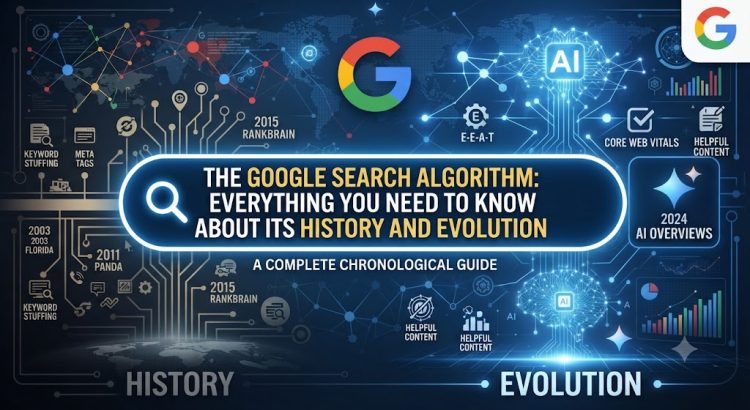
What is the Google search Engine?
A search engine is a program designed for users to find relevant information by typing keywords or search queries into search browsers.
Search engines have crawlers or spiders that explore websites and index or store website data, and they rank websites based on search algorithms and ranking parameters. Here are few top search engines:
- Microsoft Bing
- Yahoo
- Baidu
- Yandex
How Search Engine Works?
A search engine works through three main stages. Here they are:
- Crawling – In this stage, crawlers or spiders (automated search programs) visit websites to explore webpage content, links, website structure, and other information.
- Indexing – Once crawlers or spiders finish their job, the search engine organizes and stores the website data in a database; this process is called indexing.
- Ranking and Algorithm – An algorithm is designed with numerous parameters to rank a website in search results. Google’s ranking algorithm filters websites according to their metrics, and based on performance, the most suitable websites that meet the most parameters are ranked at the top.
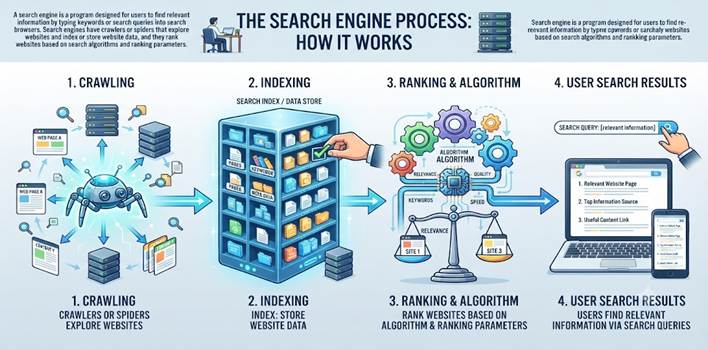
Display – Finally, the user gets relevant information based on their search queries.
Google Ranking & Quality Factors
Google search algorithm is too complex now and there are numbers of ranking factors, here are few of them:
- Quality and User-Friendly Content-
One of the key points of ranking on Google searches is having relevant, user-friendly, and informative content that understands user search intent to get more visibility and rank higher on Google search engines. Google doesn’t consider low-quality, spammy, duplicate, old, not useful, and misguiding content. Lots of not useful content is deindexed by Google; you can find them in your Google Search Console account.
- E-E-A-T (Experience, Expertise, Authoritativeness, and Trustworthiness)
Google’s quality raters and core systems heavily emphasize E-E-A-T to measure content credibility:
- Experience: Does the content demonstrate firsthand or life experience on the topic?
- Expertise: Is the creator, writer, or organization knowledgeable or qualified in the subject matter?
- Authoritativeness: Is the site recognized as a go-to source or authority by other websites and industry experts?
- Trustworthiness: Is the page accurate, honest, secure (HTTPS), and safe for users?
- Page Experience and Technical Performance
Google search gives importance to websites that have a good user experience and are technically fixed of all SEO issues. Page experience and technical performance include Core Web Vitals, mobile-friendliness, security, navigation, inner page reach, interlinking structure, etc.
- Backlinks and Authority Signals
A website having strong authority and a relevant, industry-high-quality backlink profile improves the ranking, branding, and visibility of an online business. If a website has a high-authority backlink profile, it can rank higher on Google search engines, whereas low-quality and spammy linking websites get lower ranks in searches.
Let’s talk about how Google Search Ranking worked in 1995–2005. Here is what search algorithms relied on:
- Keyword Stuffing – Adding more and more keywords within the content gave more chances to rank on search engines.
- Keyword-Loaded Meta Tags – Search engines ranked webpages that had heavily loaded keywords in the meta tags.
- No User Experience – User experience was not important for websites, and irrelevant, low-user-experience websites were ranking at the top.
- Low-Quality Backlinks – Most websites that were ranking on search engines had low-quality backlinks. SEO followed low-quality backlink building techniques like directory submission, social bookmarking, classified ads submissions, and submitting one article to multiple article submission directories etc. We were also part of this era.
The History of Google Search Algorithm Changes and Updates
Technology has changed, requirements have changed, the process has changed, search results have changed, the search algorithm has changed, and on-page and off-page SEO have changed. Almost everything has changed in the last 20 years. Here are a few important Google search engine updates to review and take care of while doing SEO, AEO, GEO, or whatever you are doing for online marketing.
List of Google Algorithms.
Florida – Google launched the Florida update in November 2003 to make search more complicated and harder to rank for SEOs who were trying to manipulate search engines using low-quality SEO techniques. Why was it named Florida? The name came after the Pubcon SEO conference in Orlando, Florida.
Brandy – Google launched brandy search algorithm in February 2004, the Brandy update introduced major changes to Google’s search algorithm, including an expanded database, improved handling of latent semantic indexing (LSI) for synonyms and related terms, stronger anchor text analysis, and a more sophisticated way of evaluating backlink relevance rather than just counting raw links.
Nofollow – In January 2005, Google, Yahoo, and MSN introduced the “nofollow” tag for external links to control the quality of outbound links and stop passing unwanted link juice, and it is still used today.
Caffeine Update – Google launched the Caffeine update in June 2010, a massive infrastructure update that allowed Google to crawl and index website webpages faster and deliver significantly up-to-date information immediately.
MayDay Update – This algorithm rolled out in May 2010, and it was created to handle long-tail search queries and rank quality and relevant webpage content higher, while lowering the rankings of websites that have automated webpage content or low-quality affiliate marketing content.
Panda Update – One of the biggest search updates in February 2011, it resulted in countless websites being penalized, deranked, and deindexed from Google. This update impacted 35 percent of searches. Google launched the Panda algorithm to penalize websites which implemented black-hat SEO techniques, low-quality content farms, and thin or duplicate content with lots of keyword stuffing. It prioritized quality over quantity and gave importance to fresh, user-friendly, and informative content.
Google rolled out the Panda algorithm regularly at short intervals.
Google Page Layout Algorithm – Google launched the Page Layout Algorithm in January 2012. This update targeted websites that placed an excessive amount of advertising “above the fold.” Google rewarded websites or webpages that had a good, user-friendly layout where users could find important information above the fold.
Penguin Update – A year after the Panda update, while few websites had recovered from Panda, Google launched the Penguin update in April 2012 without giving SEOs time to fight back. Google launched the Penguin update for those websites that were buying backlinks, creating low-quality spammy links, using PBN (Private Blog Network) websites, and using over-optimized anchor text for backlink building. The main aim of this algorithm was to penalize or deranked websites that had low-quality links and reward websites having high-authority links.
Exact Match Domain Update – In September 2012, Google launched the Exact Match Domain update to de-rank low-quality exact match domains from relevant search queries. This update shifted businesses toward buying general domain names for their brand and avoiding keyword-stuffed domain names. Lots of spammy websites with exact match domains were penalized by Google, forcing them to buy a new domain for their business instead of trying for months to recover or fix the old one.
Google Hummingbird Update – While the SEO industry was still dealing with the Google Panda and Penguin updates, Google launched the Hummingbird update in August 2013 to improve conversational search. It was created to understand the search intent behind search queries and deliver more relevant and accurate results.Hummingbird Affected 90% Of Searches.
What changed? Content creators began integrating natural, conversational question words (such as what, how, why, and where) directly into their content to better align with natural language queries.
Payday Loan Update – Google launched the Payday Loan update in June 2013, aiming to clean up spammy and low-quality payday loan, casino, and adult websites from the search results.
Pigeon Update – Google launched the Pigeon update in July 2014. This update transformed local search by improving Google’s local search results and delivering more accurate outcomes for local customers. It was also a time when local business directories, Google business listings, and citation-building became crucial for local SEO.
Quality Update (Phantom) – Initially rolling out in May 2015 (and famously tracked by SEOs as the “Phantom” update), this algorithm change focused heavily on evaluating overall site quality. It targeted thin content, “content farms”, poorly researched articles, and sites plagued by excessive, intrusive advertising that hindered user experience. By adjusting how its core ranking system assessed content value, Google aimed to demote low-quality pages and reward authoritative, user-first sources.
RankBrain – A new era began when Google launched RankBrain in October 2015, introducing machine learning (ML) and artificial intelligence (AI) to Google’s core search algorithm. That is why we are now talking about AI SEO.
Mobile-Friendly Update – True to its name, Google launched the Mobile-Friendly Update in April 2015 to boost the rankings of mobile-friendly websites. It forced website owners to make their sites responsive, ensuring they worked seamlessly across mobiles, tablets, smartphones, and all other devices.
Fred Update – Launched on March 7, 2017, this update targeted low-quality content websites, specifically penalizing sites driven heavily by aggressive monetization, low-value affiliate links, and thin or unhelpful content.
Google Broad Core Updates – Rolled out multiple times a year (with major historical shifts starting prominently around 2017–2018, such as the “Medic” update), broad core updates are sweeping changes designed to significantly improve how Google’s overall algorithm assesses overall content quality. Unlike targeted updates that penalize specific tricks like keyword stuffing or bad links, core updates broad-brush evaluate websites holistically. They reward authentic expertise, authority, and trustworthiness (E-E-A-T), re-evaluating how pages match comprehensive user intent across all industries.
Featured Snippets Update – Google launched featured snippets update in January 2020 to expanded its use of Featured Snippets (often referred to as “Position Zero”) to answer user queries directly at the top of search results.
January 2020 Core Update – Officially rolling out on January 13, 2020, this was the first broad core algorithm update of the new decade.
Google Spam Update – Google launched dedicated Spam updates in 2020, designed to target low-quality content, AI-generated spam, poor content, link schemes, link spam, cloaking, keyword stuffing, and other violations of Google’s spam guidelines to deranked websites engaging in manipulative SEO techniques.
Google Link Spam Algorithm Update – Google launched it on July 26, 2021, for link spamming techniques, buying links, affiliate links, etc.
Page Experience Update – Google launched this algorithm in 2021–2022 for mobile and desktop users and introduced CWV (Core Web Vitals) measuring website performance such as LCP and CLS.
Helpful Content Update – Initially launched in August 2022 and later integrated directly into Google’s core ranking systems, it designed for helpful webpage content for the users, high quality, informative contents for people first.
Site Reputation Abuse (SRA) Update – Google introduce site reputation abuse update in March 2024 to target third party content hosting websites.
AI Overviews – Google launched in May 2024, introduced AI-generated summaries utilizing customized Gemini models designed specifically for search.
Core Updates and Spam Updates have been integrated directly into Google’s search algorithm and are continuously updated on a regular basis at short time intervals.
Stay updated with new Google Algorithm.
