On Page SEO Techniques That Could Double Your E-commerce Website conversions

Improving traffic and optimization of e-commerce website is one of the most difficult task for online marketing experts. If we talk about the conversion, it’s really difficult to convert visitor to customer and improve conversion rate of website. Today we are going to share On-page SEO technique that can maximize organic search and conversion of e-commerce website.

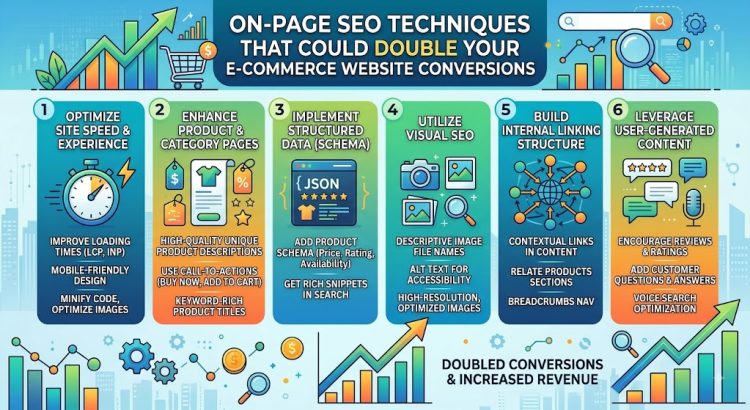
To complement and update the article with modern strategies, here are essential modern On-Page SEO techniques tailored for e-commerce websites. Adding these to the existing list will address algorithmic shifts, search intent updates, and modern user expectations:

Optimize E-Commerce Website for Core Web Vitals & Page Experience

Search engines prioritize user experience metrics directly tied to loading speed and stability:

  • Interaction to Next Paint (INP): Ensure interactive elements (like add-to-cart buttons, filter menus, and image zoom tools) respond instantly.
  • Largest Contentful Paint (LCP): Optimize main product images using dynamic next-gen formats (.webp, .avif) and set explicit dimension attributes to prevent layout shifts (CLS).

Implement Merchant Center & Product Structured Data (Extended Schema)

Beyond basic Product and AggregateRating schema, leverage rich structured data to secure visual Google Shopping snippets and AI overview inclusion:

  • Add detailed properties: shippingDetails, hasMerchantReturnPolicy, inStock, priceValidUntil, and gtin/mpn.
  • Use nested OfferShippingDetails and MerchantReturnPolicy schema to show free shipping or return policies directly in organic search snippets.
Read More

How to Use User-Generated Content in Your Instagram Influencer Marketing

User-generated content (UGC) can be the most effective way to promote your brand and convince your audience to try your products. You can use it for your influencer marketing campaigns on Instagram.

Instagram is the most suitable platform for influencer marketing, wherein celebrities and people with a large follower base spread awareness about your product.

What is UGC?

User-generated content (UGC) is any content created by real customers about your brand, products, or services. UGC comes in many formats, including customer reviews, star ratings, video testimonials, blog posts, comments, and photos.

Displaying user-generated content (UGC) on your website builds trust in your brand, products, and services. In everyday shopping, customers hesitate to buy items with zero reviews, comments, or feedback—yet they purchase with confidence when they see positive reviews from real buyers.

Why is user-generated content important?

User-generated content (UGC) is one of the most powerful tools in modern marketing because it builds genuine brand trust and loyalty. In today’s crowded digital market—where buyers encounter everything from top-tier brands to unreliable scams—authentic customer reviews and real-life photos give shoppers the confidence they need to buy.

Builds Immediate Trust & Credibility: Provides authentic social proof from real customers, making your brand instantly more relatable and reliable.

Increases Sales & Conversion Rates: Reduces buyer hesitation by showing real-world product usage, ratings, and positive feedback.

Boosts SEO & Organic Traffic: Generates a continuous stream of fresh, keyword-rich content and customer reviews that search engines love.

Saves Content Creation Costs: Delivers a steady library of authentic customer photos, videos, and testimonials without high production expenses.

Enhances Social Media Engagement: Drives higher click-through rates and interaction by featuring real people rather than polished brand ads.

Provides Valuable Customer Insights: Offers real-time feedback on what buyer’s love, helping you refine product offerings and customer support.

What is Influencer marketing?

In an era dominated by social network, influencer marketing is thefastestgrowing method of customer acquisition. About 67% of marketers are planning to increase their expenditure on influencer marketing and 89% of marketers mention that influencer marketing is comparable to or better than other marketing channels.

The reason why its adoption rate is so high is that, it gives marketers $6.50 for every dollar spent on an average, which is better than the outcomes of other marketing approaches including PPC and organic search marketing.

Read More

The Hidden Costs of Cheap SEO: Why a ₹10,000 Package Will Destroy Your Google Rankings

Every day, business owners receive emails that sound almost too good to pass up:

“Rank #1 on Google in 30 Days! Full SEO Service for only ₹9,999/month. Includes 50 backlinks, 10 articles, and keyword optimization!”

For a small business or startup watching its budget, ₹10,000 (~$120) a month feels like a low-risk experiment. But in modern search engine optimization, cheap SEO isn’t just ineffective—it is an expensive liability.

Google’s ranking algorithms—powered by AI systems like SpamBrain and strict Helpful Content guidelines—are designed to identify and penalize low-quality, manipulative tactics. What seems like a bargain today can leave your website penalized, de-indexed, or permanently damaged tomorrow.

What Cheap SEO Agencies Actually Do (And Why It Kills Rankings)

To deliver on impossible promises for a fraction of the cost, budget agencies rely on shortcuts that directly violate Google’s Search Essentials.

Read More

WhatsApp Marketing Strategies That Generate More Leads

Check out WhatsApp automation tools for your e-commerce business.

Why Does WhatsApp Lead Generation Matter?

  • Better Completions: WhatsApp has a high open rate of around 98% and a click-through rate of around 45-60%, outperforming email or SMS. Therefore, fewer people are likely to drop-off.
Read More

SEO & AI Update: How To Track & Optimize AI Search Performance

Artificial Intelligence (AI) is revolutionizing search engines, fundamentally changing how users interact with search results. Google’s Search Generative Experience (SGE), Bing AI, and other AI-driven search tools prioritize context, relevance, and conversational intent over traditional ranking factors. For businesses and SEO professionals, this shift requires new strategies for tracking and optimizing performance in AI-driven search environments.

This article provides an in-depth analysis of how AI is reshaping SEO, methods to track AI search performance, and actionable strategies to optimize content for AI-powered search engines.


Understanding AI-Powered Search

AI-driven search engines use natural language processing (NLP), machine learning, and contextual understanding to deliver more relevant and personalized results. Unlike traditional search algorithms that prioritize keyword matching and backlinks, AI search engines analyze intent, topic relevance, and user behavior to generate results dynamically.

Read More