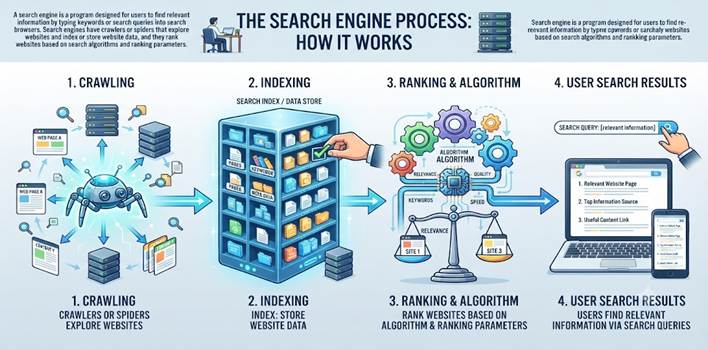
A search engine is a program designed for users to find relevant information by typing keywords or search queries into search browsers.
Search engines have crawlers or spiders that explore websites and index or store website data, and they rank websites based on search algorithms and ranking parameters. Here are few top search engines:
Google
Microsoft Bing
Yahoo
Baidu
Yandex
How Search Engine Works?
A search engine works through three main stages. Here they are:
Crawling – In this stage, crawlers or spiders (automated search programs) visit websites to explore webpage content, links, website structure, and other information.
Indexing – Once crawlers or spiders finish their job, the search engine organizes and stores the website data in a database; this process is called indexing.
Ranking and Algorithm – An algorithm is designed with numerous parameters to rank a website in search results. Google’s ranking algorithm filters websites according to their metrics, and based on performance, the most suitable websites that meet the most parameters are ranked at the top.
Display – Finally, the user gets relevant information based on their search queries.
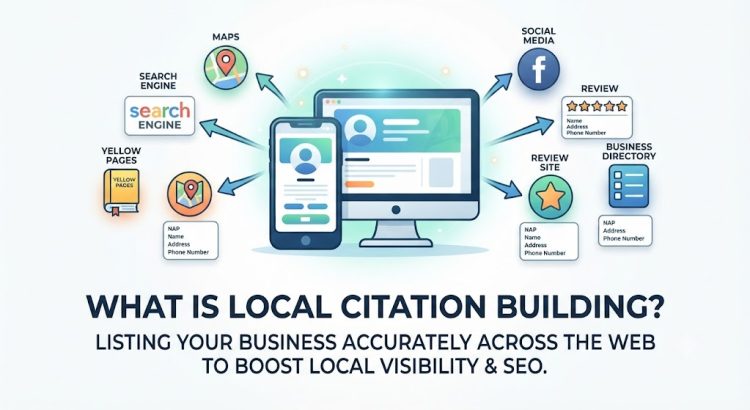
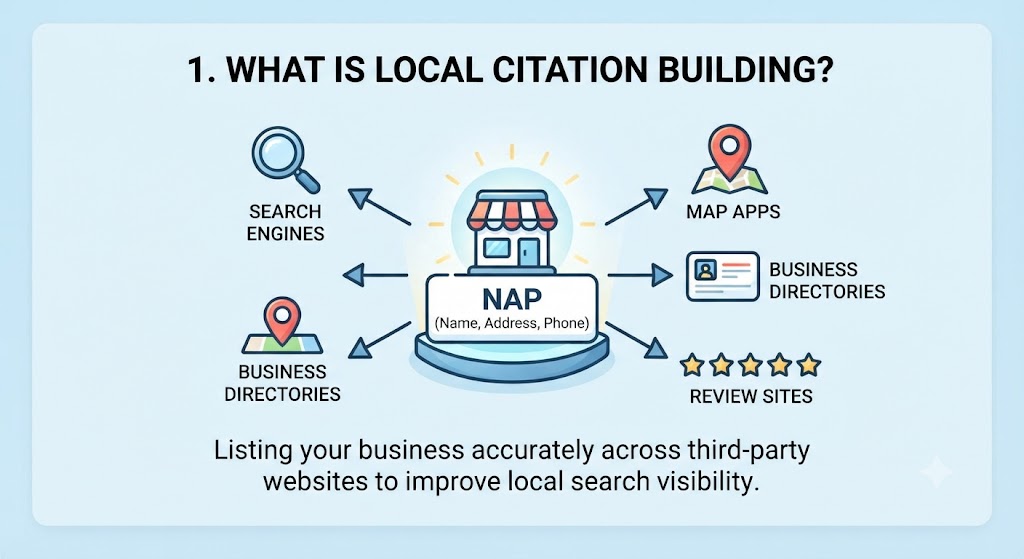
Local citation building/business listing is a local SEO marketing technique where a local business is listed on relevant third-party local business listing websites, search engines, apps, and review and rating websites with accurate information of NAP (name, address, and phone number). There are other business details that can be used for location citations, like a business description, business category, business keywords, contact email, website URL, and more.
Content-
What is local citation building? Why You Need Citation Building? What types of information are included in local listings? How to Choose the Right Local Business Listing Pages and Review Sites? Why Review and Citation building Are Crucial in Local Marketing? The Impact of Local Listings and Reviews on Consumer Decision-Making List of Local Business Listing Websites. What is listings management? Listing Management Vs Building Citations Local Listing Management Tools
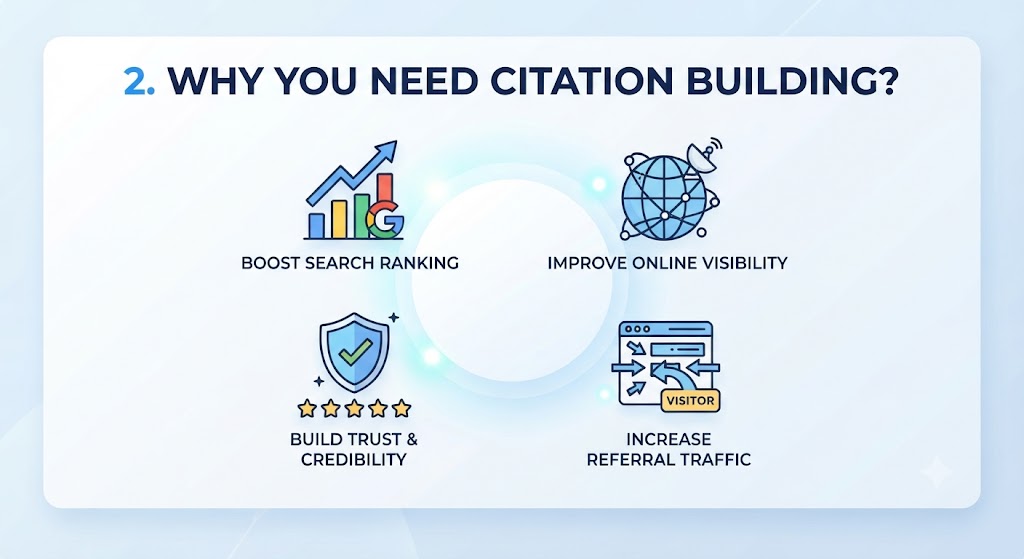
Why You Need Citation Building?
Local citation building with an accurate NAP for any online business is more important to improve local search performance on search engines on local search queries. Here are why online businesses need citation building:
Boost Search Ranking on Local Searches –
Search engines like Google use citations—such as a Google Business Profile—to verify online business details, including the location, business name, address, phone number, and more. Only verified business listings can be displayed or ranked on search engines. Listing your business on directory websites with consistent NAP information improves Google’s trust in your brand and helps your Google Business listing rank higher in search results.
Improve Online Visibility –
There are approximately 6.12 billion global internet users worldwide and some part of these users use third-party directories” (such as online business listings, yellow pages, map apps or specialized B2B/consumer directory platforms) for online business, listing businesses on local listing websites improve online business visibility.
Build Trust and Credibility –
Finding accurate business information—including NAP, user reviews, and ratings—on multiple business listing platforms builds customer trust, confidence and sends a positive signal, encouraging them to purchase your services or products.
Increase Referral Traffic –
Citation building websites do more than just improve SEO—they also drive referral traffic to your website. When users find and search for your business on local listing platforms, map apps, and review sites, positive feedback and accurate details improve your click-through rate, enhancing your business profile and generating valuable referral traffic.
Do you have an Instagram profile? Do you track Instagram Reels reviews and comments, and are you curious about checking who viewed your profile recently or in the past? Much like how LinkedIn shows a list of profile views, can you see who views your Instagram profile too?
Instagram Profile Views vs. Video Views
Instagram profile views are different from video views. Profile views indicate how many times and who has visited or reviewed your Instagram profile, whereas video views give you insights into who watched your videos and how many times. Instagram users or business profiles can access this data from Instagram Insights.
A video view is counted when a user watches your video for a minimum of three or more seconds, while a profile view is counted when someone visits your profile. Both are different and track distinct metrics.
What Signals Should You Check for Guest Blog Posting Websites?
How to Spot and Avoid Low-Quality Guest Post Sites
How to Pitch a Guest Blog Website?
How to Write High-Quality Guest Posts That Get Published
How much does it cost to get backlinks from high-authority websites?
Have you tried all SEO techniques, including on-page and off-page SEO, to improve your ranking, traffic, and sales online, yet you’re still not getting the best results? Do you ever ask your SEO company what marketing methods have been implemented and why? Have they implemented them in the right way?
Did you know that guest blog posting—or getting links from high-authority websites—is the key to online success? Guest posting involves partnering with relevant, high-authority websites, creating high-quality content for them, and getting your website link published to drive traffic, increase brand visibility, and more.
Without the right marketing plan and connections, it is hard to get high-authority backlinks for your website. Let’s discover what guest blogging is and how to do it the right way to get real benefits.
What is Guest Posting in SEO?
As marketing experts, we call guest posting by multiple names: guest blog posts, guest blogging, content outreach and publishing, ghostwriting, content marketing, and high-authority link building. In simple terms, guest blog posting is a marketing technique used to create high-quality, informative, brand mention, and service-based blog posts and publish them on relevant industry websites to generate backlinks for your website.
One big reason behind the success of ecommerce giant Amazon is – the experience they offer their consumers. If you are planning or struggling to establish a name in the ecommerce industry, you must fill the loopholes in your customer service process.
You need to put in efforts to uplift customer experience on your website and with your business. If your customers do not feel good while shopping on your website, they would not buy from you. And if they have already bought, chances are they will either cancel their order or never come to buy from you again.
No matter how effective your SEO has been at bringing new traffic to your website, if your website does not provide visitors with a sense of security and a powerful load of convenience – it will lack on the revenue part, because they would not prefer buying from you.
All your efforts to build a strong online presence for your ecommerce setup sink down when you fail to please your visitors and customers.
What Exactly does the Term Customer Experience Involve?
Customer experience is a broad term. It is often described as the practice of designing and reacting to meet and exceed the expectations, leading to greater customer satisfaction and loyalty.