
Holiday season is just round the corner, and consumers are readying themselves for a brisk shopping drive. It’s also the time of the year when businesses compete head-to-head with other in order to lure as much people as possible.
So, what’s your idea to woo your consumers and make historic sales this holiday season?

It’s the perfect time to overhaul your SEO strategy, include holiday-specific elements in your optimization process, and implement techniques that will drive more traffic to your website. In fact, by not preparing your online store and not engaging in a right manner with your consumers, you might lose a great deal of opportunity in terms of increased sales. Thus the coming season is a rare opportunity to create a greater impact on your holiday visitors.
Here are some of the highly actionable tips for improved traffic and better conversion this holiday season:
Optimize website or holiday pages for AI searches and answer first content
Conversional optimization or q&A format contents still play crucial role to get raked on AI searches, so we need to add answer first blocks or sentence on the top of the webpages and improve header structure of web page content that help your webpage ranked on the AI searches.
Build Evergreen “Holiday Hubs”:
Instead of creating new, year-specific landing pages annually—which are difficult to rank in time—use permanent URLs like /holiday-gifts, /christmas-gifts, or /valentines-day-gifts. Keeping these URLs active year-round preserves search authority, allowing them to consistently rank at the top of Google every season.
Optimize for Low-Friction Mobile Experience (INP & LCP)
Because most holiday shopping happens on mobile, fast performance directly drives search rankings and sales. Boost conversions by optimizing Core Web Vitals (INP and LCP) through script deferral and image compression, then pair speed with frictionless checkouts like Apple Pay
Website Structure, UI & UX Optimization for Holidays
An effective e-commerce presence relies on seamless user experience (UI/UX) and a robust site architecture. Consistent page design and intuitive navigation not only guide shoppers effortlessly through the buyer journey but also enhance overall search engine performance.
Beneath the visual interface, a reliable infrastructure—including web hosting, server applications, plugins, and extensions—ensures your site functions smoothly. During peak holiday shopping, traffic spikes can easily overwhelm servers and cause site crashes. Investing in high-performance web hosting with scalable bandwidth, strong security, and low latency is essential to maintain speed, prevent downtime, and maximize seasonal conversions.
In other words, the architecture holds a key in improving your search engine rankings.
- Optimize your sitelinks for holidays
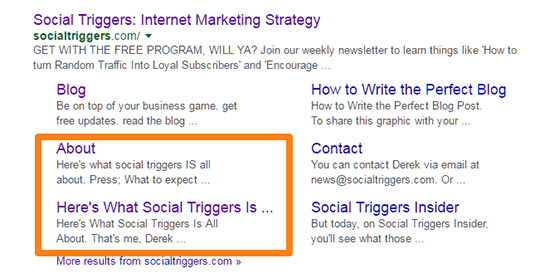
Sitelinks are hyperlinks to website subpages that appear under certain Google listings in order to help users navigate the site. They make the navigation process easy by placing important links within the search results. Being easy shortcuts, sitelinks streamline the user interface and get users to the pages they want to visit. Also, sitelinks help your site become more visible because of an increased space for your ads, which means higher click through rates (CTR).
The following figure shows relevant sitelinks:
- Use a correct internal linking structure
Internal linking is an essential part of your SEO strategy. As a matter of fact, search engines rank individual pages in SERPs, rather than websites as a whole. Since your e-commerce website must have hundreds of pages, which means internal pages also need to get traffic apart from the home page. This is where internal linking comes into play. For example, linking your homepage to a product page means some of the trust factor is transferred from the homepage to that product page. You can also link blogs or informative contents to the relevant product page.
The following figure shows the correct linking structure:
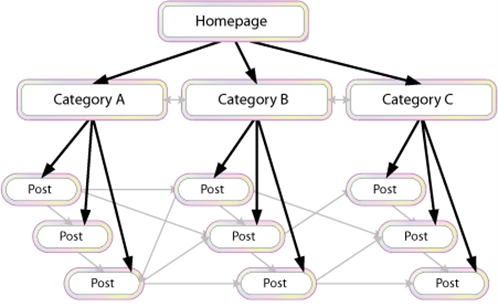
An optimized e-commerce internal linking structure uses a shallow flat hierarchy (3–4 clicks max depth) to pass link equity and streamline user navigation:
- Homepage (Depth 0): Links directly to primary categories and key promotional hubs.
- Category / Sub-category Pages (Depth 1–2): Link down to curated product collections and laterally to related categories.
- Product Pages (Depth 2–3): Cross-link via “Related Products,” “Frequently Bought Together,” and upward breadcrumbs to parent categories.
- Cart & Checkout Pages (Depth 3–4): Linked from products and persistent site headers, keeping navigation minimal to eliminate friction and complete purchases smoothly.
Use Breadcrumb Navigation
This is yet another good strategy used to direct users to various important pages on your e-commerce website. It is also known as the secondary navigation since it shouldn’t use your main website navigational structure. Its main advantage is it makes it easier for search engines to crawl through your website and help users to navigate.
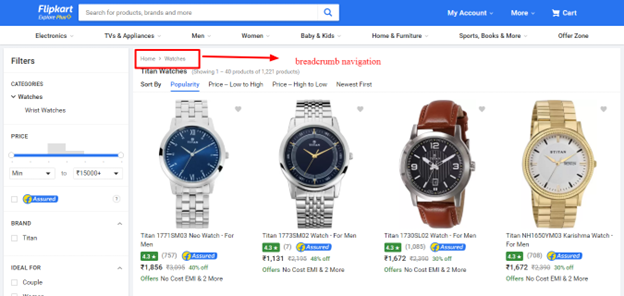
The above image is a product category based-breadcrumb which helps to identify the path and where you are in the hierarchy of the website.
- Make it a mobile-friendly site
More and more people are using smartphones and tablets for online shopping purposes, which is why your website needs to be optimized for mobile devices. According to Statista, as of January 2018, total mobile e-commerce sales were $1.8 trillion. It is expected to reach $3.56 in 2021. Another study suggests 30% of consumers tend to abandon a transaction if the website is not optimized for a mobile device.
These statistics clearly prove the essence of a mobile-friendly website. In fact, Google rewards websites that are mobile-responsive by allowing them to rank better in search results. Moreover, holidays are the time when users spend more time on their smartphones – chatting, browsing, and shopping.
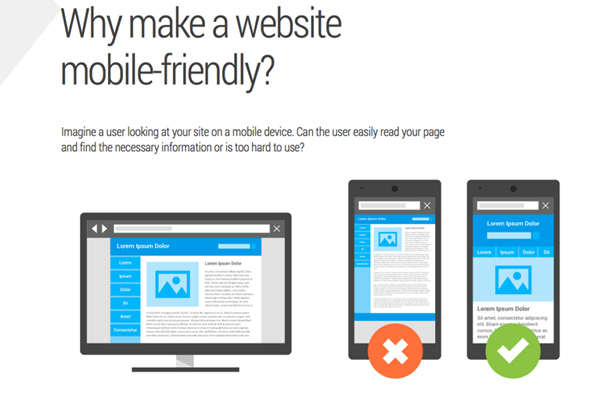
To make your site mobile-friendly, you need to have a responsive design. A responsive web page is the one that detects and identifies user’s screen size, which means the layout changes accordingly. A responsive design allows you to successfully boost the user experience of your e-commerce site. In this way, you can provide an omni-channel or a unified shopping experience.
- Include accurate local business listings and holiday offers
With the beginning of holiday season and an associated euphoria, your local consumers will also start making their lists and search the items at nearby locations. With a lot of shoppers making a beeline to storefronts, many of them will be eying for any pre-rush sales. So what it means is it’s the right time for you to be mighty visible because your prospects are aggressively browsing the web. If you fail to tweak and improve your listing, you will miss out on the holiday consumers, big time.
It’s time to check out the old listings and correct them if they contain former business address or old telephone numbers or previous contact info. The logic is simple – due to inaccurate contact details, your customers won’t reach you and your business will be hampered. Plus, it reflects how badly you are prepared and it will look unprofessional on your part. Particularly in any holiday season, the general perception is online brands should be directly accessible. Therefore, your location data management should have accurate core name, address, and phone number (NAP) information, along with links to your website and physical directions to the store.
You can also use tools like BrightLocal or TribeLocal to create and track your local citations, spot NAP issues, and find new citation sites. You will be able to make the entire process of filtering local listings in directories easy, quick and efficient.
- Get listed on Google My Business page
Google My Business (GMB) page is a great way to ensure and boost your visibility. Customers use GMB to locate and contact trustworthy businesses in their local area. So incorporating extended business hours in GMB page will boost your traffic and positively affect your revenues. Google already has a list of holidays for which it supports special hours and you can add them there. It will also help you gain a competitive advantage by claiming, updating, and interacting with customers through Google My Business page listings.
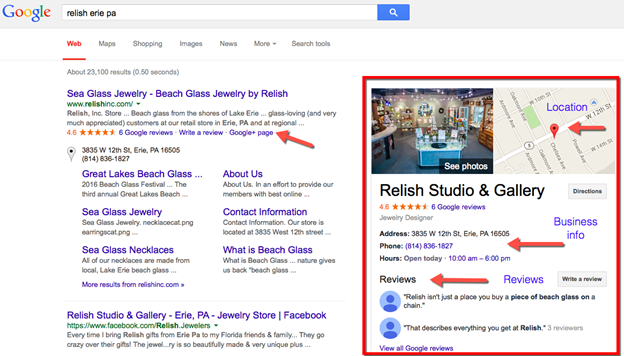
This is how you can optimize your Google My Business and local directory listings:
- Log in to your Google My Business account, select the location that you want to set special hours for.
- Add your business hours and special holiday hours to your listings. It will ensure that customers will know when you are open.
- If you have already satisfied customers, you can add their reviews. Similarly, you can add photos and questions & answers.
- Feed the address, phone numbers, and website of your business so that customers can find you.
- Describe what your business has to offer and include important keywords in your description.
- Incorporate holiday-centric pay-per-click advertising
It shouldn’t surprise you – many people start for searching Christmas gifts as early as October. It is observed that the holiday season begins after Halloween, which is when traffic levels shoot up. This is the appropriate time when you have to start marketing your campaigns, too. It will make sure you are in your customers’ mind before they start their shopping spree.
According to a recent stat, during holidays, ad impressions increase 50% and consequently direct traffic goes up by 150%. The increased holiday traffic leads to more clicks and better buyer intent, that’s when PPC spending increases massively around this time of the year.
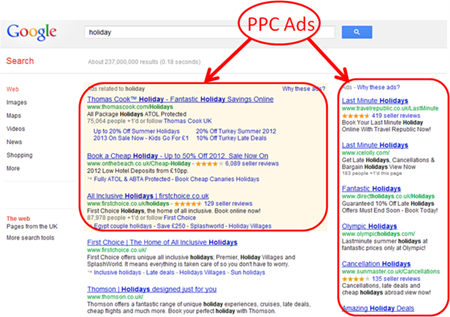
If you are contemplating to run PPC campaigns, you need to modify your ads in order to incorporate holiday-centric keywords. Make the content attractive so that people feel like clicking on the ads to find out what you have to offer. You can also use ad extensions to make your advertisements stand out from the rest. Apart from these you need to improve your transaction process to boost ROI. You can make your e-commerce transaction process user friendly by adding extensions like Magento Order Management to the site, which will enhance the order process and help users manage their multiple orders relatively easily.
Holiday shoppers typically want – “deals” that attract them to make a purchase decision; “location” of popular products for gifting purpose. This is where a strong PPC advertising can give you a distinct advantage. So make a list of your most popular products or generate deal-focused or holiday-focused search terms. Furthermore, your existing PPC data can tell you a lot about what keywords to target and which products to promote.
- Leverage social media for holiday marketing
Combining social media with your holiday SEO strategy amplifies reach, organic traffic, and conversions:
- Visual & Social Channels: Leverage Facebook and YouTube for traffic, and Pinterest and Instagram for visual product discovery. Use trending holiday hashtags to increase brand visibility.
- Proactive Engagement: Stay active by sharing exclusive holiday coupons, special offers, and providing fast customer support.
- Data-Driven Personalization: Use native analytics (Meta Insights, X Analytics, Google Analytics) to understand customer preferences. Tailored content boosts purchase likelihood by 40%.
Create holiday-centric landing pages
During holiday shopping, the attention span of consumers is reduced because of obvious competition. At a time when businesses are busy in sprucing up their storefronts, your smartly optimized landing pages can give you an edge.
Just consider this, during the shopping rush if a consumer has to choose between a busy homepage and a targeted page that highlights exact customer needs, whom will he/she choose? Thus a well-optimized landing page will make all the difference. As an online business owner, you have to greatly rely on lead generation, so holiday-specific and optimized landing page will help you capture lead information that can be used right away or later. It encourages visitors to click-through to an offer, thereby bringing them into the sales funnel.
It’s widely seen many people search for holiday-themed sales, deals, and offers. So marketing a page with related content and information will give you the opportunity to show up for consumers. You need to make good use of holiday-themed content, which will help you build authority and drive sales. A good example of high quality content, especially for landing pages is Frac.tl’s sales-driven customized content for specific objectives. Hence, with a clear message, relevant info, and targeted offers, you can convert your prospects’ clicks into add-to-carts.
Summary
Holiday season is at the doorstep, and businesses as well as consumers are gearing up in their own ways for this big event.
If you are ready to grab this opportunity to efficiently increase your sales, a little revision of your SEO strategy can put you at a clear advantage.
Since SEO comprises many smaller and bigger techniques, the above tips are some important among them. There could be many more methods that you can incorporate in order to revamp your last minute SEO tricks for holiday sales.
