The one constant thing in the digital world is CHANGE. That means if you don’t acknowledge or fully embrace it, your brand risks being left behind by evolving trends.
If you pause and think about web design, it has come a long way since the early days of basic, text-heavy layouts. Today, it’s hard to imagine a successful website without dynamic interactions, high-definition visual storytelling, micro-animations, and fast, mobile-optimized performance. If your website looks dated compared to your competitors, you risk losing potential clients every second.
The digital marketing landscape is shifting rapidly. Technologies that felt cutting-edge just a few years ago are now basic baseline expectations. New innovations, evolving search algorithms, and shifting consumer habits move so fast that falling behind means letting competitors take the lead.
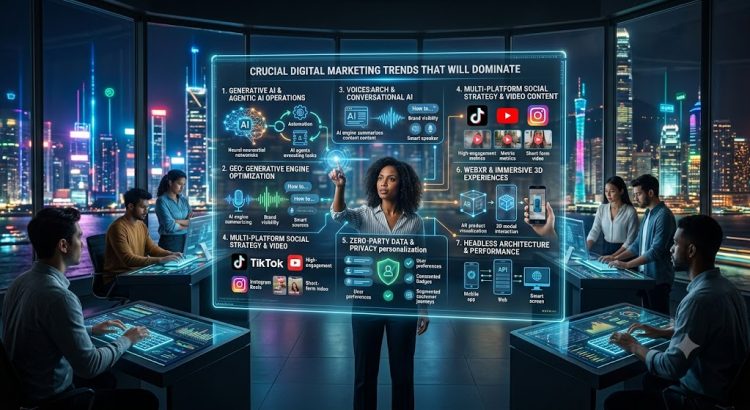
It’s time to look toward the future. Here are crucial digital marketing trends you need to embrace to stay ahead, keep your audience engaged, and scale your brand.
Artificial Intelligence Will Shape Digital Marketing
Artificial intelligence is no longer just a trend—it’s a core operational engine. Marketers rely heavily on AI to personalize user journeys, analyze predictive data, and streamline content workflows. AI integration has transformed from a competitive luxury into an everyday standard for digital marketing.
Chatbots and generative AI interfaces are prime examples. Modern AI assistants go far beyond simple rule-based scripts; they provide personalized, 24/7 customer support, answer complex product queries instantly, and capture qualified lead data. Unlike traditional support setups, AI tools handle unlimited simultaneous conversations smoothly and cost-effectively, significantly improving customer experience while reducing acquisition costs.
Coping with Advanced Voice Search and Conversational Queries
With the explosion of smart speakers, voice assistants, and voice-activated mobile searches, conversational search is a major driver of web traffic. People don’t search with voice the same way they type—they use natural, long-tail questions and localized phrases.
This means web owners must optimize content not just for traditional keywords, but for how people naturally speak. Integrating conversational AI optimization and direct-answer formatting into your SEO strategy is essential for capturing this high-intent traffic.
Social Media Strategy Requires a Multi-Platform Approach
With billions of active social media users globally; customer attention is distributed across multiple ecosystems. Maintaining a presence on just a single platform is no longer enough to scale a modern brand.
Your ideal YouTube or TikTok audience may interact differently than users on LinkedIn or Instagram. To maximize brand recognition and conversion, marketers must strategically adapt content for each specific platform’s format—from short-form video to structured professional posts—meeting target clients directly where they spend their time.
Video Content Dominates Internet Traffic
Video continues to dominate user attention across every channel. While well-written text illustrates your mission, video communicates it faster and builds immediate visual trust through product demos, customer testimonials, and authentic behind-the-scenes content.
Short-form video, live streams, and interactive webinars drive significantly higher dwell time, boost conversion rates, and account for the vast majority of consumer internet traffic. To maximize impact, integrate mobile-optimized, high-quality video across your landing pages and social media strategy consistently.
Native Advertising and Subtle Content Integration
Modern consumers have developed ad fatigue and frequently rely on ad blockers to skip intrusive pop-ups and commercial banners. Traditional push advertising often gets ignored if it interrupts the user experience.
Zero-Party Data and Privacy-First Personalization
With stricter privacy regulations, the phase-out of third-party tracking cookies, and growing consumer ad-fatigue, passive data collection is being replaced by consent-driven relationships. The focus has shifted to Zero-Party Data—information customers explicitly and intentionally share with a brand (such as preferences, style quizzes, purchase intents, and interactive survey responses). In exchange, consumers receive tailor-made offers, product recommendations, and hyper-personalized digital experiences. Designing interactive touchpoints that collect zero-party data builds deep consumer trust while ensuring full compliance with modern privacy standards.
Interactive WebXR and Spatial/3D Experiences
Web interfaces are moving away from flat, static layouts toward immersive, spatial environments. Powered by lightweight WebXR frameworks, modern sites allow visitors to interact with products in 3D or Augmented Reality (AR) directly within their mobile or desktop browser—no separate app installation required. Whether it’s previewing furniture inside a living room, trying on apparel virtually, or exploring interactive 3D product customizers, spatial web features significantly boost user dwell time and increase buyer confidence before checkout.
Headless Architecture and Composable Commerce
Behind the scenes, the traditional “all-in-one” website stack is giving way to Headless Architecture. By separating the front-end display (the UI) from the back-end database via APIs, brands can deliver near-instant load times, eliminate layout shifts, and push content simultaneously to smart screens, mobile apps, and web browsers. This modular approach allows marketers to update design elements and launch new digital experiences in seconds without disrupting the core web infrastructure or impacting Google Core Web Vitals performance.
Conclusion:
Navigating the digital landscape is challenging as technological innovations, shifting trends, and changing algorithms raise the bar for competing with rivals. The trends outlined above can serve as a guide toward success. Selecting these high-impact predictions will help your brand catch up, adapt, and lead in the modern market.
