Holiday SEO Strategy: Actionable Tips to Implement for Greater Conversion This Holiday Season

Holiday season is just round the corner, and consumers are readying themselves for a brisk shopping drive. It’s also the time of the year when businesses compete head-to-head with other in order to lure as much people as possible.

So, what’s your idea to woo your consumers and make historic sales this holiday season?

It’s the perfect time to overhaul your SEO strategy, include holiday-specific elements in your optimization process, and implement techniques that will drive more traffic to your website. In fact, by not preparing your online store and not engaging in a right manner with your consumers, you might lose a great deal of opportunity in terms of increased sales. Thus the coming season is a rare opportunity to create a greater impact on your holiday visitors.

Here are some of the highly actionable tips for improved traffic and better conversion this holiday season:

Optimize website or holiday pages for AI searches and answer first content

Conversional optimization or q&A format contents still play crucial role to get raked on AI searches, so we need to add answer first blocks or sentence on the top of the webpages and improve header structure of web page content that help your webpage ranked on the AI searches.

Build Evergreen “Holiday Hubs”:

Instead of creating new, year-specific landing pages annually—which are difficult to rank in time—use permanent URLs like /holiday-gifts, /christmas-gifts, or /valentines-day-gifts. Keeping these URLs active year-round preserves search authority, allowing them to consistently rank at the top of Google every season.

Optimize for Low-Friction Mobile Experience (INP & LCP)

Because most holiday shopping happens on mobile, fast performance directly drives search rankings and sales. Boost conversions by optimizing Core Web Vitals (INP and LCP) through script deferral and image compression, then pair speed with frictionless checkouts like Apple Pay

Website Structure, UI & UX Optimization for Holidays

An effective e-commerce presence relies on seamless user experience (UI/UX) and a robust site architecture. Consistent page design and intuitive navigation not only guide shoppers effortlessly through the buyer journey but also enhance overall search engine performance.

Beneath the visual interface, a reliable infrastructure—including web hosting, server applications, plugins, and extensions—ensures your site functions smoothly. During peak holiday shopping, traffic spikes can easily overwhelm servers and cause site crashes. Investing in high-performance web hosting with scalable bandwidth, strong security, and low latency is essential to maintain speed, prevent downtime, and maximize seasonal conversions.

Read More


E-commerce Conversion Rate Optimization Statistics You Need to Know in 2026

As per Forbes, it is assumed that 24% of purchases are expected to be made online by the year 2026, along with ecommerce sales forecast to grow over 10% this year.

As stiff competition in the e-commerce industry will continue in 2026, CRO (conversion rate optimization) remains the most powerful lever for boosting the company’s revenue without significant spending on campaigns. Companies like iCustomLabel.com are investing in digital performance and user experience, and the standards for a high-converting online store are growing at a fast pace. By the end of this year, every eCommerce business should have an idea about the latest CRO statistics and benchmarks to stand out in today’s competitive market and improve profitability.

What Is Conversion Rate Optimization?

Conversion Rate Optimization (CRO) is the process of increasing sales and conversions—such as buying a product, signing up for a service, submitting an inquiry, or filling out a form—to achieve marketing goals.

Here is a formula to calculate conversion rate:

If 1,000 people visit your landing page and 25 of them sign up, your conversion rate is:

Conversion optimization helps convert users into customers and reduce cart abandonment by optimizing landing pages, checkout processes, funnel mapping, and drop-off points while lowering bounce rates.

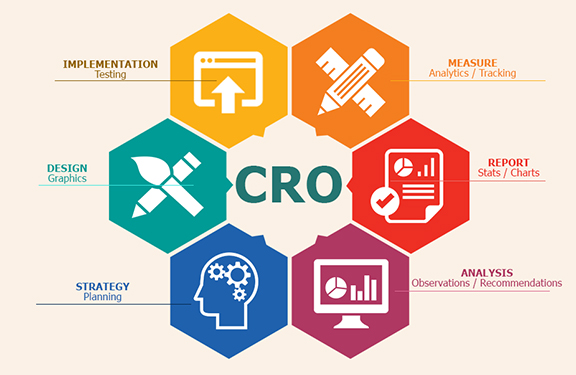
What is the Core CRO Process?

Data Analysis & Research: Collecting data from multiple sources—such as Google Analytics, heatmaps, and user surveys—to identify drop-off points, UI/UX issues, checkout friction, and other user obstacles for continuous improvement.

Improve Friction Points: Identify issues and optimize the checkout or drop-off pages where users are leaving or abandoning the website.

Testing: Testing is key to CRO success. Run A/B tests or multivariate tests by randomly splitting traffic between the original design (Control) and the updated version (Variant) to evaluate improvements and measure success before making changes permanent.

Implementation: Permanently applying the winning variant and analyzing the overall impact on revenue or leads.

Here are some typical metrics used for CRO:

  • Overall conversion rate
  • Add-to-cart rate
  • Cart abandonment rate
  • Checkout completion rate
  • Revenue per visitor (RPV)
  • Average order value (AOV)

What Do Average Conversion Rates Look Like?

1. Global Average E-commerce CRO – When we talk about the overall average, it is expected to remain steady in the range of 2.5% to 3.5%. However, major brands may see conversion rates ranging
from 5% to 10%.

Read More

Crucial Digital Marketing Trends that will Dominate

The one constant thing in the digital world is CHANGE. That means if you don’t acknowledge or fully embrace it, your brand risks being left behind by evolving trends.

If you pause and think about web design, it has come a long way since the early days of basic, text-heavy layouts. Today, it’s hard to imagine a successful website without dynamic interactions, high-definition visual storytelling, micro-animations, and fast, mobile-optimized performance. If your website looks dated compared to your competitors, you risk losing potential clients every second.

The digital marketing landscape is shifting rapidly. Technologies that felt cutting-edge just a few years ago are now basic baseline expectations. New innovations, evolving search algorithms, and shifting consumer habits move so fast that falling behind means letting competitors take the lead.

It’s time to look toward the future. Here are crucial digital marketing trends you need to embrace to stay ahead, keep your audience engaged, and scale your brand.

Artificial Intelligence Will Shape Digital Marketing

Artificial intelligence is no longer just a trend—it’s a core operational engine. Marketers rely heavily on AI to personalize user journeys, analyze predictive data, and streamline content workflows. AI integration has transformed from a competitive luxury into an everyday standard for digital marketing.

Read More

Modern Web Design Trends: How UI Patterns Drive Engagement and Core Web Vitals

Responsive design, mobile readiness, and flat UI aesthetics have evolved from modern novelties into baseline web standards. However, creating a functional layout is no longer enough to keep visitors engaged—or to satisfy search engine algorithms.

Psychological research shows that users form an opinion about a website’s visual appeal in as little as 50 milliseconds (0.05 seconds), with 94% of initial impressions directly tied to design and layout. Furthermore, data from Google and Deloitte reveals that improving site responsiveness by just 0.1 seconds increases conversion rates by over 8%.

To capture attention within this narrow window, modern web architecture relies on specific technologies:

  • Google Core Web Vitals: Standards measuring LCP (Largest Contentful Paint for loading), INP (Interaction to Next Paint for responsiveness), and CLS (Cumulative Layout Shift for visual stability).
  • Next-Gen Media Engines: Leveraging lightweight AVIF/WebP image formats and vector graphics to deliver high-resolution visual storytelling without sacrificing performance.
  • Hardware-Accelerated UI: Utilizing lightweight CSS transitions instead of heavy JavaScript threads to keep user interactions smooth and low-latency.

When executed together, these technical and visual patterns turn passive browsing into an engaging, high-performing digital experience.

Read More

The Hidden Costs of Cheap SEO: Why a ₹10,000 Package Will Destroy Your Google Rankings

Every day, business owners receive emails that sound almost too good to pass up:

“Rank #1 on Google in 30 Days! Full SEO Service for only ₹9,999/month. Includes 50 backlinks, 10 articles, and keyword optimization!”

For a small business or startup watching its budget, ₹10,000 (~$120) a month feels like a low-risk experiment. But in modern search engine optimization, cheap SEO isn’t just ineffective—it is an expensive liability.

Google’s ranking algorithms—powered by AI systems like SpamBrain and strict Helpful Content guidelines—are designed to identify and penalize low-quality, manipulative tactics. What seems like a bargain today can leave your website penalized, de-indexed, or permanently damaged tomorrow.

What Cheap SEO Agencies Actually Do (And Why It Kills Rankings)

To deliver on impossible promises for a fraction of the cost, budget agencies rely on shortcuts that directly violate Google’s Search Essentials.

Read More